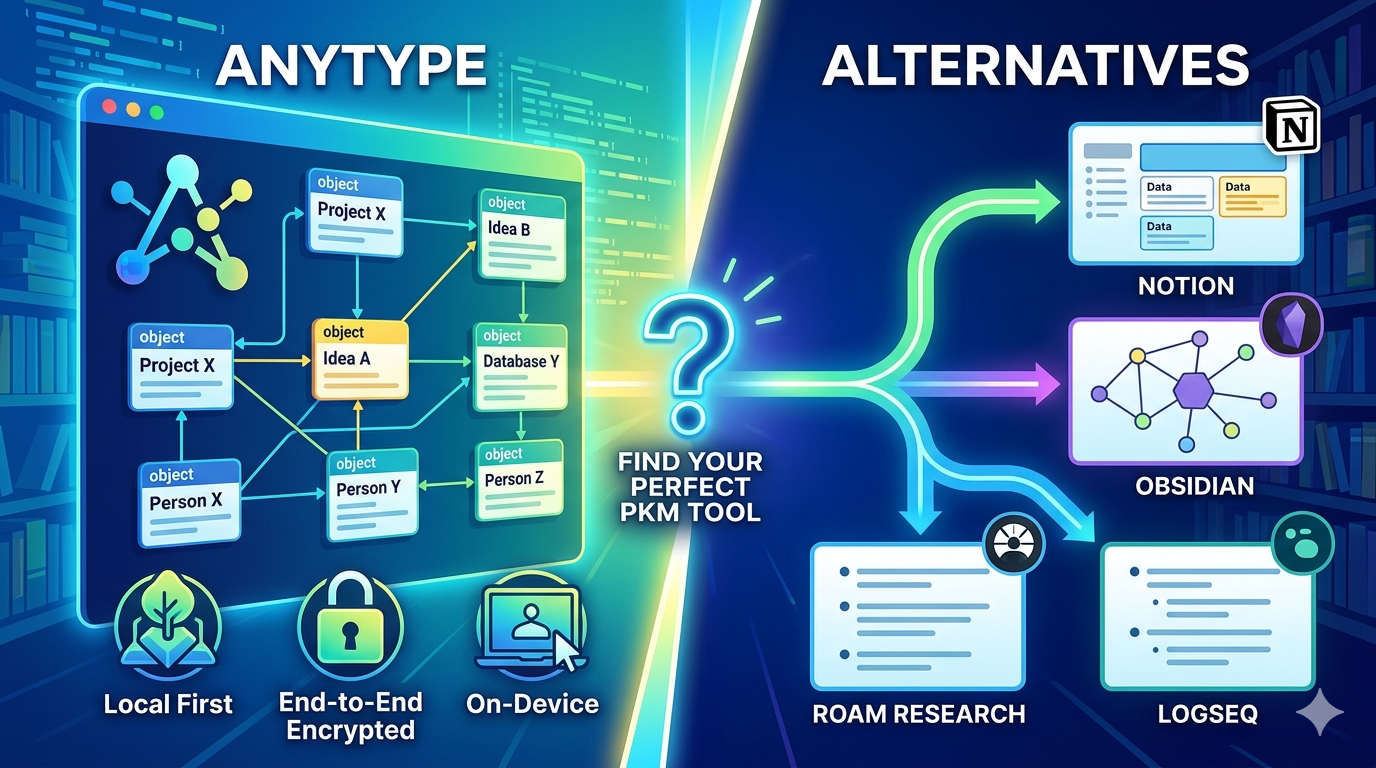
Looking for AnyType alternatives? You’re not alone. AnyType has gained popularity as a privacy-focused, local-first workspace for notes, tasks, and knowledge management. However, many users seek alternatives due to its steep learning curve, evolving stability, and limited third-party integrations.
This comprehensive guide covers the 10 best AnyType alternatives in 2026. We’ll compare features, pricing, privacy features, and use cases to help you find the perfect tool for your productivity needs. Whether you want local-first markdown, cloud-based collaboration, or open-source knowledge management, you’ll find detailed comparisons here.
Here’s how all 10 AnyType alternatives compare across key criteria:
| Tool | Best For | Pricing | Offline | Open Source | Privacy |
|---|---|---|---|---|---|
| Obsidian | Local-first PKM | Free (sync $4/mo) | Yes | No | High |
| Notion | Team collaboration | Free + $10/mo | Limited | No | Medium |
| Logseq | Daily notes, open source | Completely free | Yes | Yes | High |
| AFFiNE | Visual creative work | Free + team plans | Yes | Yes | High |
| Capacities | Object-based, polished UI | Free + $9/mo | No | No | Medium |
| AppFlowy | Notion-like, self-hosted | Free + $5/mo | Yes | Yes | High |
| Joplin | Traditional notes | Free + €2.4/mo | Yes | Yes | High |
| Standard Notes | Maximum privacy | Free + $2.50/mo | Yes | Partial | Highest |
| Roam Research | Networked thought | $15/month | No | No | Medium |
| Craft Docs | Apple document design | Free + $10/mo | Limited | No | Medium |
AnyType’s object model is powerful but has a steep learning curve. New users often spend hours understanding types, relations, and sets before becoming productive. Notion and Obsidian have lower initial friction.
Users also report occasional sync issues, missing features compared to Notion, and a UI that changes significantly between versions. The mobile apps lag behind the desktop experience, particularly for complex object creation. Limited third-party integrations also frustrate teams relying on automation workflows with tools like Zapier, Slack, or GitHub.
AnyType prioritizes privacy and local-first storage with end-to-end encryption. Your data stores locally on your device and encrypts before touching AnyType servers. The app is source-available and free to use during beta.
AnyType positions itself as a personal knowledge base—a digital brain designed for capturing, describing, and connecting information seamlessly. It offers an offline-first approach that many users find refreshing compared to cloud-based competitors like Notion.
With AnyType, you can create books, tasks, notes, and essentially anything, organizing items however you see fit. The platform uses an object-oriented approach where everything is a “type” (books, people, projects, notes) that links together naturally.
Key AnyType features include:
AnyType pricing includes a free plan with 100 MB remote storage and 10 shared spaces. The Plus plan costs $5/month ($4/month yearly) with 1 GB storage. Pro costs $10/month ($8/month yearly) with 10 GB storage. Ultra costs $20/month ($16/month yearly) with 100 GB storage.
Despite these strengths, users seek alternatives for better stability, mature features, easier onboarding, or specific workflows. Let’s explore the best alternatives.
Obsidian stands out as the closest spiritual successor to AnyType, featuring local-first storage and a 4.7/5 rating. It operates on local Markdown files, offering unparalleled data ownership and a highly customizable experience through its extensive plugin ecosystem.
Often hailed as a powerful tool for building a “second brain,” Obsidian excels in networked thought with its graph view, allowing users to visualize connections between notes.
Local Markdown Files: Plain markdown files on your disk with no proprietary format. Your data remains readable forever, even without Obsidian.
Bidirectional Linking: Create links between notes using double brackets [[ ]]. Build a network of interconnected ideas that reveals connections over time.
Graph View: Visualize relationships between notes in an interactive graph. See clusters of related content and discover hidden connections.
Extensive Plugin Ecosystem: Hundreds of community plugins extend functionality. Add calendars, kanban boards, tasks, AI assistants, and more.
Powerful Search: Full-text search across all notes with advanced query syntax. Find anything instantly.
Templates and Snippets: Create reusable templates for consistent note formatting. Speed up your workflow with predefined structures.
Cross-Platform: Available on Windows, Mac, Linux, iOS, and Android. Your markdown files work everywhere.
Obsidian is completely free for personal use with all core features included. You get unlimited notes, full plugin access, and complete control over your data at no cost.
Optional paid services include:
Pros:
Cons:
Obsidian works best for individuals who want local-first notes with a large plugin ecosystem. It’s ideal for researchers, students, writers, and knowledge workers building a personal knowledge management system. Choose Obsidian if you value data ownership, markdown files, and extensive customization.
Obsidian wins for users wanting mature stability, plain text files, and extensive plugins. AnyType wins for users wanting built-in sync, object-based organization, and a more integrated experience.
Notion is a widely popular all-in-one workspace that combines notes, tasks, databases, and wikis. While primarily cloud-based, it offers immense flexibility with its block-based editor and templates, making it a strong contender for those prioritizing comprehensive features and collaboration over strict local-first privacy.
Notion represents the trade-off between privacy and capability. You sacrifice local-first storage for feature depth, integrations, and ecosystem maturity.
Block-Based Editor: Every element is a block—text, images, tables, code, videos. Drag and drop blocks to rearrange content instantly.
Powerful Databases: Create relational databases with multiple views (table, board, calendar, gallery, timeline). Link databases together for powerful connections.
Linked Views: Display the same database data in multiple views. Show project tasks as a board on one page and a calendar on another.
Templates Gallery: Thousands of community and official templates for wikis, project management, meeting notes, and more. Get started instantly.
AI Integration: Notion AI (add-on) helps generate content, summarize notes, and automate workflows. It acts as a writing assistant within Notion.
Collaboration Features: Real-time collaboration, comments, mentions, and permissions. Work together seamlessly with teams.
Extensive Integrations: Far more integrations than AnyType with Slack, GitHub, Google Drive, Figma, and 1000+ tools.
API Access: Robust API for custom integrations and automation workflows.
Notion offers a generous free plan for personal use with unlimited pages and blocks. Paid plans include:
Notion AI costs an additional $10/month per user.
Pros:
Cons:
Teams that want full feature depth and third-party integrations choose Notion. It’s ideal for project management, team wikis, collaborative documentation, and organizations needing robust permissions. Students and individuals who prioritize convenience over privacy also benefit.
Choose Notion for polished UI, collaboration features, templates, and cloud convenience. Choose AnyType for privacy, offline work, data ownership, and custom data structure.
Logseq is a privacy-first, open-source knowledge base that uses an outliner-style interface with daily journals and robust bidirectional linking. It stores notes as local Markdown or Org files, emphasizing long-term data ownership and fast capture.
As a fully free and open-source tool, Logseq appeals to users who want transparency, community-driven development, and complete control over their data.
Outliner Interface: Bullet-point based organization with nested lists. Capture thoughts quickly in a hierarchical structure.
Daily Journals: Automatically create daily notes with timestamped entries. Build a chronological log of your thoughts and tasks.
Bidirectional Linking: Link pages and blocks with double brackets. See all references to a page in the “Related” section.
Local-First Storage: All data stores as plain text Markdown or Org files. No vendor lock-in, future-proof format.
Graph View: Visualize connections between pages in an interactive graph. Explore your knowledge network.
Query System: Build powerful queries to find notes based on tags, properties, and content. Automate information retrieval.
Task Management: Built-in task tracking with TODO, DOING, DONE states. Schedule tasks with due dates and priorities.
Flashcards: Create spaced-repetition flashcards for learning. Built-in Anki-style review system.
Logseq is completely free and open source. No paid tiers, no premium features, no subscriptions. All features available to everyone forever.
Pros:
Cons:
Daily note-takers and PKM users who want a free local-first outliner choose Logseq. It’s perfect for researchers, students, and knowledge workers who journal daily and value open-source software. Researchers and knowledge workers prioritizing AI-powered note-taking also favor Logseq.
Logseq wins for daily journaling, open-source transparency, and outliner lovers. AnyType wins for object-based organization, polished UI, and mobile experience.
AFFiNE positions itself as an open-source, local-first alternative to Notion. It offers a workspace with fully merged documents, whiteboards, and databases. AFFiNE aims to provide a flexible and privacy-conscious environment for creators and teams.
AFFiNE combines note-taking, database, and visual whiteboard in one modern, privacy-first platform. It’s ideal for flexible and creative workflows that need both documentation and visual brainstorming.
Documents + Whiteboards: Fully merged documents and edgeless whiteboards. Switch between doc mode and canvas mode seamlessly.
Database Views: Create tables, kanban boards, calendars, and galleries. Link databases to documents for rich connections.
Local-First: Works offline with local storage. Your data stays on your device with optional sync.
Open Source: Fully open-source with self-hosting options. Community-driven development with transparency.
Real-Time Collaboration: Multiple users edit simultaneously with conflict-free merging. Built on CRDTs for smooth collaboration.
AI Integration: Inline AI assists with writing, summarization, and content generation.
Rich Blocks: Text, images, videos, code, embeds, and more. Drag and drop blocks to arrange content.
AFFiNE is free for individuals with premium plans for advanced team features. Pricing details vary based on team size and collaboration needs.
Pros:
Cons:
Teams and creative professionals who need real-time collaboration and a hybrid doc + whiteboard setup choose AFFiNE. It’s perfect for visual creators, designers, and teams wanting documentation combined with brainstorming canvas.
AFFiNE wins for visual creators wanting docs + whiteboards. AnyType wins for privacy-focused users wanting decentralized P2P sync and object-based organization.
Capacities offers object-based note-taking with connected knowledge, similar to AnyType’s object model but cloud-hosted and more polished. It uses typed objects—books, people, notes, projects—that link to each other naturally.
Capacities provides a more accessible UI than AnyType for the same conceptual model. Users who like AnyType’s object philosophy but want a polished cloud interface choose Capacities.
Object-Based System: Typed objects (books, people, notes, projects, meetings) with specific properties. Each object type has relevant attributes.
Natural Linking: Objects link to each other automatically based on relationships. See all books by an author or all meetings with a person.
Visual Library: Beautiful media-rich interface with cover images, previews, and rich formatting. More visually appealing than text-heavy tools.
Daily Notes: Built-in daily journal with timeline view. Track your thoughts and tasks chronologically.
Relations and Tags: Connect objects through relations and organize with tags. Build a web of connected knowledge.
Cloud-Hosted: Sync across devices automatically with cloud storage. No manual sync setup required.
Polished UI: Refined, intuitive interface with smooth animations. Easier onboarding than AnyType.
Capacities offers a free plan with paid Pro upgrades at $9/month. Both Capacities and AnyType are currently free during their respective beta periods.
Pros:
Cons:
Users who like AnyType’s object model but want a polished cloud UI choose Capacities. It’s ideal for individuals wanting structured organization without steep learning curves. Those prioritizing ease of use over privacy also benefit.
Capacities wins for polished UI and easier onboarding. AnyType wins for mobile support, privacy, and local-first storage.
AppFlowy is an open-source Notion alternative with local storage. It’s self-hosted, open-source, and built to mirror Notion’s UX with documents, kanban boards, and grids. AppFlowy is Rust-based for performance.
AppFlowy offers a more Notion-like interface than AnyType with the same local/self-hosted privacy benefits. Teams wanting Notion’s interface with self-hosted control choose AppFlowy.
Notion-Like Interface: Familiar layout with pages, databases, and blocks. Easy transition from Notion.
Open Source: Fully open-source with active community development. Transparent codebase you can audit.
Local Storage: Data stores locally on your device. Optional self-hosting for full control.
Database Views: Tables, kanban boards, calendars, and grids. Multiple views of the same data.
Markdown Support: Strong markdown support for formatting and fast writing.
Rust-Based Performance: Built with Rust for fast, efficient performance.
Customizability: Extensible architecture for custom plugins and features.
AppFlowy is completely free and open-source. Optional cloud hosting starts at $5/month for collaborative features. The open-source nature allows customization and data control.
Pros:
Cons:
Teams who want a Notion-like interface with self-hosted control choose AppFlowy. It’s perfect for developers, privacy-conscious users, and organizations needing custom deployments. Those valuing transparency and data ownership also benefit.
AppFlowy wins for Notion-like interface and open-source control. AnyType wins for object-based organization and decentralized P2P sync.
Joplin is an open-source, privacy-focused note-taking application that provides a more traditional note-taking experience with Markdown support and basic task management. It offers reliable offline use and various syncing options, including self-hosting, aligning with AnyType’s privacy ethos.
Joplin handles large volumes of notes organized into notebooks. It features full Markdown support, end-to-end encryption, and seamless synchronization across devices.
Notebooks and Notes: Traditional hierarchical organization with notebooks and subnotebooks. Familiar structure for classic note-takers.
Full Markdown Support: Write in Markdown with live preview. Export to various formats including PDF, HTML, and ePub.
End-to-End Encryption: Encrypt notes before syncing. Only you hold decryption keys.
Multiple Sync Options: Sync via Dropbox, OneDrive, Nextcloud, or self-hosted Joplin Server. Choose your preferred cloud provider.
Offline Access: Full offline functionality with local storage. Access notes without internet.
Web Clipper: Browser extension to save web pages and articles. Capture research and references.
Cross-Platform: Available on Windows, Mac, Linux, iOS, and Android. Consistent experience across platforms.
Plugin System: Extensible with community plugins for additional features.
Joplin is free and open-source. Paid Joplin Cloud starts at €2.4/month for hosted sync and collaboration features. Self-hosting remains completely free.
Pros:
Cons:
Users prioritizing privacy and end-to-end encryption with traditional note-taking choose Joplin. It’s ideal for those wanting a simple, secure, cross-platform note-taking app. Users leaving Evernote for open-source alternatives also migrate to Joplin.
Joplin wins for traditional note-takers wanting simple, secure notes. AnyType wins for all-in-one workspace with object-based organization.
Standard Notes offers a simple, secure, and cross-platform note-taking experience for users whose paramount concern is privacy and end-to-end encryption. It focuses on core note-taking with robust security features.
Standard Notes provides self-hosting options for complete data control and customization. It extends into secure and encrypted notes as its primary specialization.
End-to-End Encryption: All notes encrypt client-side before syncing. Zero-knowledge architecture means even Standard Notes can’t read your notes.
Simple Interface: Clean, minimalist design focused on writing. No distractions or complex features.
Cross-Platform: Available on all major platforms including web, desktop, and mobile. Consistent encrypted experience.
Self-Hosting: Full self-hosting options for complete data control. Run your own server for maximum privacy.
Extensions: Optional extensions add editors, themes, and productivity tools. Customize your experience.
Longevity: Established tool with over a decade of operation. Proven track record of security.
Standard Notes offers a free plan with basic features. Premium plans start at $2.50/month for advanced editors, themes, and syncing. Extended plans include additional features for power users.
Pros:
Cons:
Users whose paramount concern is privacy and end-to-end encryption choose Standard Notes. It’s perfect for journalists, activists, lawyers, and anyone handling sensitive information. Those wanting simple, secure notes without complex features also benefit.
Standard Notes wins for maximum privacy and proven security. AnyType wins for comprehensive knowledge management with object-based organization.
Roam Research is a pioneer in networked thought, known for its powerful graph-based note-taking and bidirectional linking. It helps users build interconnected webs of ideas. Researchers and deep thinkers particularly favor Roam Research.
Roam’s bidirectional linking is the most intuitive implementation. It offers easier discovery and more effective serendipitous outcomes compared to Obsidian and AnyType.
Bidirectional Linking: Automatic backlinks show every page referencing current content. See the full context of connections.
Daily Notes: Automatic daily pages for journaling and task capture. Build a chronological knowledge base.
Graph View: Visual network showing connections between notes. Explore relationships in 3D interactive graph.
Block-Level Linking: Link to specific blocks (bullet points), not just pages. Create granular connections.
Query System: Powerful queries to find content based on links, tags, and content. Automate information retrieval.
Unstructured Flexibility: No folders or rigid structure. Let your knowledge organize organically through links.
Roam Research costs $15/month for unlimited blocks and collaborators. Free tier includes 2,000 blocks. Educational discounts available for students and teachers.
Pros:
Cons:
Researchers and deep thinkers building interconnected webs of ideas choose Roam Research. It’s perfect for academic researchers, writers working on complex projects, and anyone valuing networked thought. Those prioritizing discovery through linking also benefit.
Roam wins for networked thought and intuitive linking. AnyType wins for privacy, offline access, and cost.
Craft Docs is a beautiful document editor for Apple-first teams. It’s Apple-native with stunning typography and document design. Craft focuses more on beautiful writing than AnyType’s structured object model.
Craft is better for teams prioritizing document aesthetics over data organization. It excels at creating polished, shareable documents.
Apple-Native Design: Built specifically for macOS and iOS with native performance. Follows Apple design guidelines perfectly.
Beautiful Typography: Stunning fonts, spacing, and formatting. Documents look professional by default.
Document Design: Focus on creating beautiful, shareable documents. Rich media embedding and layout options.
Block-Based Editor: Similar to Notion with drag-and-drop blocks. Flexible content arrangement.
Daily Notes: Built-in daily notes with timeline view. Capture thoughts and tasks.
Cross-Platform: Available on Mac, iOS, iPadOS, and web. No native Windows or Linux apps.
Export Options: Export to PDF, Word, Markdown, and more. Share documents easily.
Craft offers a free plan for personal use. Teams plan costs $10/user/month for collaboration features and unlimited documents.
Pros:
Cons:
Apple-first teams prioritizing beautiful document design choose Craft. It’s perfect for writers, designers, and anyone creating polished documents for sharing. macOS and iOS users valuing aesthetics over complex organization also benefit.
Craft wins for Apple users wanting beautiful documents. AnyType wins for cross-platform support and knowledge management.
Local-first tools (Obsidian, Logseq, AFFiNE, AppFlowy, Joplin, Standard Notes) store data on your device. Cloud tools (Notion, Capacities, Roam, Craft) store data on their servers. AnyType offers local-first with P2P sync.
For maximum control, choose tools with plain text formats (Obsidian, Logseq). For convenience, choose cloud tools with automatic sync.
End-to-end encryption appears in AnyType, Obsidian (with Sync), Logseq, Joplin, Standard Notes, and AFFiNE. Standard Notes offers the strongest privacy commitment. Cloud tools store data on their servers with varying encryption.
Fully open-source tools include Logseq, AFFiNE, AppFlowy, and Joplin. AnyType is source-available but not fully open-source. Proprietary tools include Notion, Capacities, Roam, and Craft.
Notion offers best-in-class collaboration with real-time editing. AFFiNE also provides excellent real-time collaboration with CRDTs. AnyType has shared spaces. Obsidian and Logseq have limited collaboration.
AnyType has the steepest learning curve due to its object model. Notion and Capacities offer easier onboarding. Obsidian and Logseq have moderate curves. Standard Notes is simplest.
Notion and AnyType have good mobile apps. Obsidian and Logseq have decent but less polished mobile apps. Craft is Apple-only. Capacities has no mobile app (as of 2025).
Free options include Logseq (completely free), Obsidian (free with paid sync), Joplin (free with optional cloud), and AppFlowy (free open-source). Paid options range from $2.50/month (Standard Notes) to $15/month (Roam).
AnyType is still worth using for privacy-conscious users who prefer decentralized P2P networks and object-based data organization. However, its steep learning curve, evolving stability, and limited integrations lead many users to more mature alternatives like Obsidian or Notion.
Logseq is the best completely free AnyType alternative with no paid tiers. Obsidian is free for personal use (paid for sync). AppFlowy is free as open-source software. All three offer local-first storage and privacy features.
Standard Notes offers the best privacy with zero-knowledge architecture and proven 10+ year security track record. AnyType offers strong end-to-end encryption with local-first P2P sync. Obsidian, Logseq, and Joplin also prioritize privacy with local storage.
Notion is the best AnyType alternative for teams with best-in-class collaboration, permissions, and integrations. AFFiNE also offers excellent real-time collaboration for creative teams. AppFlowy works for teams needing self-hosted control.
Obsidian is more mature and stable than AnyType for personal knowledge management. It offers plain markdown files, extensive plugins, and free core features. However, AnyType offers better built-in sync, object-based organization, and mobile apps. Choose Obsidian for stability and plugins. Choose AnyType for integrated object-based workflow.
Logseq is excellent for students due to completely free pricing, daily notes, task management, and flashcards. Obsidian is also great with free personal use and extensive academic plugins. Both work offline for studying without internet.
Yes, but migration depends on the target tool. AnyType’s proprietary format makes direct migration challenging. Export your data as text/markdown where possible. Obsidian and Logseq accept markdown imports. Notion imports from various formats. Manual reorganization may be necessary.
Notion has the most polished mobile apps with full feature parity. AnyType has good mobile apps that lag slightly behind desktop. Obsidian and Logseq have functional but less polished mobile apps. Craft is best for iOS but has no Android version.
Logseq is the best fully open-source AnyType alternative with active community development, local-first storage, and daily notes. AFFiNE and AppFlowy are also fully open-source with different focuses (visual workspace and Notion-like interface, respectively).
Notion AI, AFFiNE AI, and Obsidian (with AI plugins) support AI features. Notion AI costs $10/month additional. AFFiNE includes inline AI. Obsidian requires community plugins for AI functionality.
Choosing the right AnyType alternative depends on your priorities. If you value privacy and local-first storage, Obsidian, Logseq, and AFFiNE offer strong alternatives. If you prioritize collaboration and features, Notion is unmatched. If you want open-source transparency, Logseq, AFFiNE, and AppFlowy are excellent choices.
Top Recommendations by Use Case:
AnyType remains a compelling option for privacy-focused users who invested time learning its object model. However, the alternatives offer varying strengths that may better match your workflow. Test 2-3 tools that match your priorities before committing. Most offer free tiers or trials.
Your perfect tool balances privacy, features, ease of use, and cost. Consider your primary use case (personal knowledge, team collaboration, writing, research), platform requirements (Apple-only, cross-platform), and budget (free vs. paid) when deciding. The best note-taking app is the one you’ll actually use consistently.
Keywords: AnyType alternatives, best AnyType alternatives 2026, Obsidian vs AnyType, Notion vs AnyType, Logseq alternative, knowledge management tools, personal knowledge management, PKM tools, local-first note-taking, open-source note-taking, bidirectional linking, second brain tools, note-taking apps, productivity tools, privacy-focused note-taking
If you have been searching for the right note-taking or knowledge management app, you have…
Notion is a popular all-in-one workspace, but many users seek alternatives for different needs (free…
Logseq is a beloved tool in the personal knowledge management (PKM) community. It's free, open-source,…
Looking for a Webshare alternative? You're not alone. Webshare is a popular proxy service with…
Docker changed software development forever. It made containers accessible, gave developers a simple workflow, and…
Docker makes it easy to spin up containers. The problem? Those containers pile up fast.…